Wake Forest University

Phishing

red "no" sign over Phone Scams language

Phone Scam Claiming to be NC Police

There have been a handful of instances where members from our Wake Forest community have been contacted by someone claiming to be from a North Carolina Sheriff’s office. These bad actors have, in some cases, cited individual’s correct addresses, and listed a number of offenses with fraudulent citation numbers trying to collect fines. Protect yourself from these fradulent attacks.

Verify that information is coming directly from a reputable vendor by looking up the company’s phone number. 
hook capturing paper of username and password

Unwarranted multi-factor authentication scams

Beware of phishing attempts via unwarranted multi-factor authentication (MFA or two-step verification) prompts (known as prompt-bombing). Recent observations indicate that phishers may retrieve a valid username/password combination and enter this valid information into an authentication point. The legitimate user receives the MFA prompt via SMS or an authentication app to confirm their login. If the legitimate user confirms the login, the phisher now has access to the legitimate user’s account. 

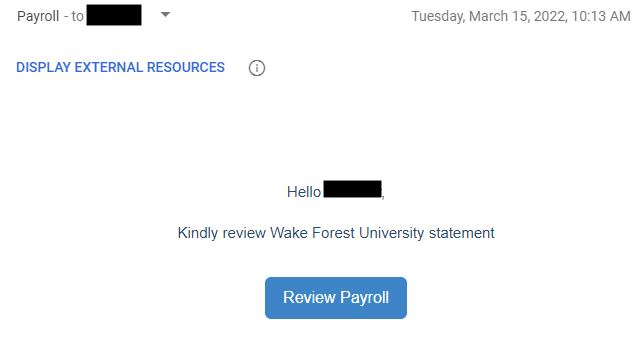
screenshot of phishing email reading "Hello NAME, Kindly review Wake Forest University statement" with "Review Payroll" button.

Recent Phishing Scam Imitating WFU Payroll

Beware of phishing notifications presumably coming from WFU payroll. Be sure to scrutinize message content, as well as the source, before responding to the sender or interacting with embedded links and/or attachments. This particular phishing scheme prompts users, who click the “Review Payroll” button, to download a malicious software package.

hand holding a phone with a crossbones image indicating smishing

Recent phishing scams imitating financial institutions

Presently, there is a text phishing “smishing” campaign imitating financial institutions with alarming messages regarding account security issues. Be sure to scrutinize message content when opening texts, as well as the source before responding to the sender or interacting with embedded links and/or attachments. Following is an example of a recent fraudulent text message. It… Read More »

image of a cyber criminal with a fishing pool attempting to catch a file of personal data

Phishing for your Credentials

Presently, there are several recurring phishing email campaigns directed at a number of WFU recipients with the purpose of harvesting account information, such as username/passwords. These phishing attempts are quite sophisticated so we want to raise awareness of what you should be looking for when opening your Inbox. Be sure to scrutinize message content, as… Read More »

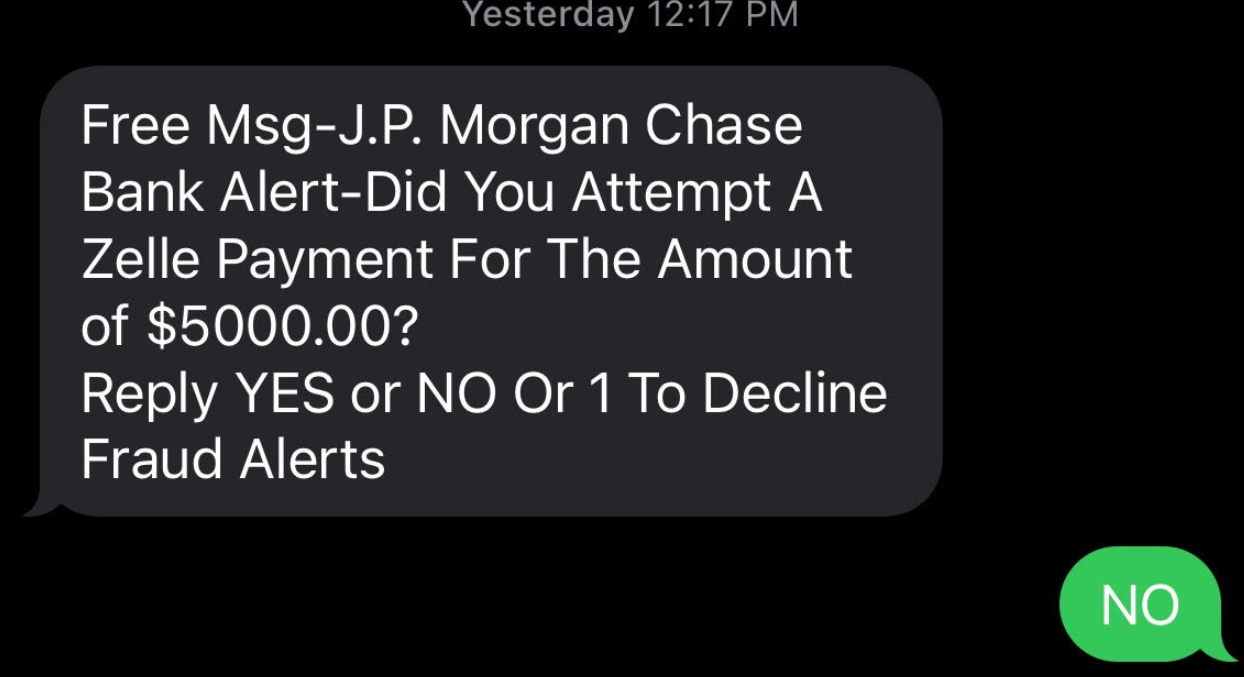
screenshot of smish "Free Msg-J.P. Morgan Chase Bank Alert - Did you attempt a Zelle payment for the amount of $5000.00? Reply YES or NO Or 1 To Decline Fraud Alerts"

Bank Fraud SMS Phish Followed by Phone Phish

Be alert for fraudulent SMS messages asking users to confirm a payment, followed up by a phone call from the hackers mimicking the fraud department of that bank.

When in doubt, hang up, look up the number of the organization supposedly calling you, and call back.

the words fraud alert on a laptop screen

FedEx Phishes

Be on the lookout for holiday phishing scams. A current scam includes recently-created, funky-looking domains, that look very similar to that of FedEx, impersonating failed deliveries.

hand reaching out of computer for money and a credit card indicating a phishing scam

Watch out for Survey Scams

Scammers are creatively offering cash for your participation in their survey and there is an abundance of these scams focused around the COVID-19 pandemic. Be vigilant to check for common red flags such as grammatical errors and spacing issues. Scammers often will use the name of a Wake Forest employee, but have a mismatched or… Read More »

hand holding a cell phone that reads scam likely

Students: Watch for Part-time Job Phishing Scams

Recent phishing scams offer fake part-time jobs as research assistants. Scammers may impersonate Wake Forest professors or departments. Be vigilant and check for common red flags. Scammers often use the name of a Wake Forest employee, but have a mismatched or generic Gmail address, instead of a legitimate WFU address. These emails often contain grammatical… Read More »

image of a phishing hook on an email envelope icon

Students: Be Aware of Recent Phishing Scams

We have seen an uptick in phishing scams offering fake jobs such as research assistants and personal assistants. Scammers may impersonate Wake Forest professors or other employees. Be vigilant to check for common red flags. Scammers often use the name of a Wake Forest employee, but have a mismatched or generic Gmail address, instead of… Read More »